

At a glance
-
Choose your scooter based on the terrain you use most.
-
Good suspension and ground clearance matter on rough ground.
-
Pneumatic tyres can improve comfort on uneven surfaces.
-
Grass, gravel and hills each need different capabilities.
-
More off-road capability often means more size and weight.
If you want to travel across grass, gravel, hills or uneven paths, you need a mobility scooter built for more than smooth pavements.
Your ideal scooter depends on where you travel, the distances you cover and how much space you have for storage and transport.
What makes a good off-road mobility scooter?
Finding the best mobility scooter for rough terrain is about more than choosing the biggest motor or highest top speed. Look for:
-
Ground clearance: More space underneath the scooter can help it negotiate ruts, roots and uneven surfaces without catching.
-
Tyres: Pneumatic tyres contain air, which can provide useful cushioning on uneven ground. Tread and tyre size also affect grip.
-
Suspension: This helps absorb bumps and vibrations, improving comfort on rougher surfaces.
-
Stability: A stable four-wheel platform can be useful outdoors, although no scooter is suitable for every slope or surface.
-
Range: Longer or more demanding journeys need sufficient battery capacity, with a sensible reserve.
-
Gradient rating: This tells you the maximum slope specified by the manufacturer. It shouldn’t be treated as a target in every weather or surface condition.
A rugged appearance alone doesn’t make a scooter suitable for all-terrain use. Compare measurable specifications with the conditions you actually expect to encounter.
Best off-road mobility scooters by use case
The right scooter for off-road journeys depends on how and where you plan to use it.
Best for more demanding outdoor use: R-1
Based on its published specifications, the R-1 is the strongest R-Series option for more demanding outdoor journeys.
It has 133mm of ground clearance, 330mm wheels, pneumatic tyres and all-round suspension. Its published maximum range is 30 miles, while the maximum slope is 10°.
The sprung captain’s seat is designed to provide additional cushioning over rougher surfaces.
The main compromise is size. At 125kg and 692mm wide, the R-1 is very different from a lightweight folding scooter. You’ll need suitable access, storage and transport arrangements.
Best compact outdoor option: R-2
The R-2 provides several outdoor-focused features in a lighter package than the R-1.
It features pneumatic tyres, suspension, a 10° maximum slope and 16.7-mile maximum range. At 90kg, it’s still a substantial scooter, but significantly lighter than both the R-1 and R-3.
Its shorter range means it may be less suitable if you regularly plan particularly long journeys.
Best for everyday outdoor journeys: R-3
The R-3 offers a balance between outdoor capability, range and carrying capacity.
Its pneumatic tyres and suspension help smooth out uneven surfaces, while 57mm of ground clearance gives you useful clearance for everyday outdoor routes.
With a maximum range of 21 miles, it gives you enough flexibility for longer trips as well as day-to-day journeys. Its maximum user weight is 28st 8lb.
We designed the R-3 with longer journeys in mind, including routes such as countryside towpaths where comfort and stability matter.
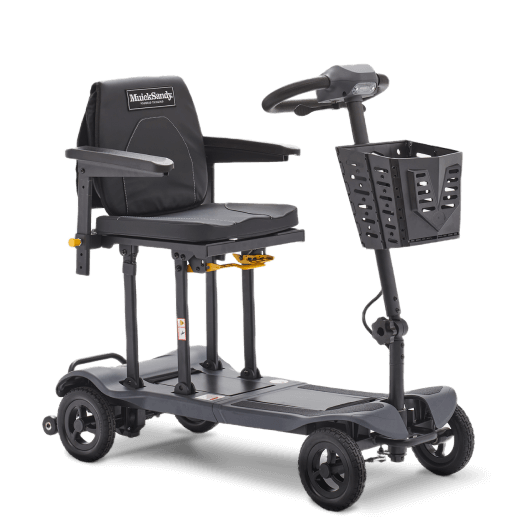
If easy car transport is more important to you than rough-terrain performance, our lightweight mobility scooters are designed with portability in mind.
Which mobility scooter is best for grass, gravel and hills?
Choosing a mobility scooter for grass and gravel means looking closely at the condition of the surface.
Firm, dry grass is generally less demanding than wet or soft grass. Likewise, compacted gravel presents a different challenge from deep, loose stones.
For these surfaces, compare:
-
Tyre size, tread and construction
-
Ground clearance
-
Suspension
-
Stability
-
Wheel size
-
Manufacturer guidance on suitable terrain
Mud and soft sand are more demanding again. Never assume “all-terrain” means a scooter is designed to cross every surface.
If hills are your main concern, the best mobility scooter for steep hills should be chosen using the manufacturer's gradient rating alongside traction, braking, stability and load.
The R-1, R-2 and R-3 all have a maximum slope of 10°. But conditions are still important. A firm, dry hill is different from the same gradient covered in wet grass or loose gravel.
How to choose the right all-terrain mobility scooter
When deciding which scooter to buy, start with the journeys you actually make. Ask yourself:
-
What surfaces will I regularly cross? Consider grass, gravel, tracks, hills and ordinary pavements.
-
How far do I travel? Treat published ranges as maximum figures rather than guaranteed real-world distances.
-
How important is comfort? Look at suspension, seating, adjustability and leg room.
-
Where will I keep it? Measure doors, gates and storage areas before buying a larger scooter.
-
Will I transport it by car? More serious outdoor capability often comes with extra size and weight.
Where possible, testing a scooter in your own environment can also help you judge comfort, access and suitability more effectively than specifications alone.
Can off-road mobility scooters be used on UK roads and paths?
The rules depend on the scooter’s classification.
In Great Britain, Class 2 mobility scooters usually have a maximum speed of 4mph. Class 3 scooters usually have a maximum speed of 8mph, can be used on roads and must be registered with the DVLA.
Class 2 and Class 3 scooters can use pavements and pedestrian areas, including footpaths and bridleways, where the maximum speed is 4mph.
Some unusually large, heavy or fast off-road vehicles can fall outside these classifications, so check the rules for the specific model rather than assuming every off-road mobility scooter is treated in the same way.
Find an off-road scooter with Muick Sandy
The best off-road mobility scooter is the one that suits the routes you actually want to travel.
Prioritise tyres, suspension, ground clearance, stability, range and gradient capability rather than choosing on speed or appearance alone. Just as importantly, consider whether the scooter will fit through your gates, into your storage space and into your wider routine.
Our R-Series gives you several options if you want more confidence on rougher outdoor routes, with different balances of range, size and capability.
Arrange a free home demonstration to find a mobility scooter suited to your routes, comfort requirements and everyday needs.
Off-road mobility scooter FAQs
Can mobility scooters go on grass?
Some suitably specified mobility scooters can travel over firm grass. Wet, soft or steep ground is more challenging, so always check the individual manufacturer’s guidance on suitable terrain.
Are four-wheel mobility scooters better for rough terrain?
Four wheels can provide useful stability, but they are only one part of the picture. Tyres, suspension, ground clearance, wheel size and the scooter’s overall design are also important.
Does off-road use reduce mobility scooter range?
It can. Hills, rough surfaces, load, temperature, tyres and battery condition can all affect real-world range, so published maximum figures should not be treated as guaranteed distances.
Can an off-road mobility scooter fit in a car?
Some can, but larger all-terrain scooters are often much heavier than folding or dismantling models. If car transport is important to you, check the scooter’s exact dimensions and weight before buying.