

At a glance
-
Single motor scooters are often a good choice for everyday pavement journeys and portable designs.
-
Dual motor scooters can provide more power and traction for hills and more demanding terrain.
-
Some dual motor systems can also improve manoeuvrability, although zero-turn capability depends on the individual scooter design.
-
Motor count alone does not determine range, portability or whether a scooter is Class 2 or Class 3.
If you're comparing single vs dual motor mobility scooters, the biggest question is how each setup affects the way a scooter feels and performs in everyday use.
But motor count is only one factor. Scooter weight, tyres, battery capacity, suspension, ground clearance and overall design all make a difference too.
Here, we'll explain how single and dual motor systems compare, and what to consider when deciding which setup best suits the journeys you want to make.
Understanding single and dual motor mobility scooters
Many single motor mobility scooters use one electric motor to drive the rear wheels through a transaxle or differential. It's a simple, well-established setup that can provide smooth and efficient power for everyday journeys.
A dual motor scooter uses two motors rather than one, usually with separate motors driving the powered wheels. Depending on how the scooter is designed, this can provide more torque, improve traction or allow the wheels to be controlled more independently.
That doesn't mean every dual motor scooter will outperform every single motor model. The power of the motors, gearing, battery, tyres, weight and chassis design all affect how a scooter performs
Single motor configurations
A single motor setup is common across many mobility scooters.
For everyday pavement journeys, shopping trips and smoother surfaces, a well-designed single motor provides plenty of usable power. Single motor systems are also found on many lightweight and portable scooters, where keeping overall weight manageable is particularly important.
The important thing is to look at the scooter as a whole rather than assuming one motor means limited performance. Maximum gradient, user weight, battery capacity and the manufacturer's guidance on suitable terrain will tell you far more about what an individual scooter can comfortably manage.
Dual motor configurations
Dual motor scooters use two drive motors, which can provide extra torque and share the work required to move the scooter.
This can be useful on scooters designed for steeper slopes, rougher surfaces or heavier loads. Some dual motor designs also use independent control of the powered wheels to achieve a much tighter turning circle.
However, dual motors don’t necessarily mean zero-turn steering. That capability depends on how the steering and drive system have been designed.
How do single and dual motors perform on UK hills and terrain?
On smooth pavements, high streets and indoor shopping areas, a single motor scooter can provide comfortable, efficient everyday performance.
As routes become steeper or rougher, motor power becomes more important – but it shouldn't be considered in isolation. Tyres, ground clearance, suspension, scooter weight, gearing and the manufacturer's maximum gradient all affect how confidently a scooter can tackle more demanding ground.
Here's a useful way to think about the differences:
|
Terrain or feature |
Single motor scooters |
Dual motor scooters |
|
Flat pavements and shops |
Well suited to everyday journeys |
Also well suited, depending on size and design |
|
Hills |
Capability varies by motor, gearing and maximum gradient |
Can offer more torque on models designed for steeper ground |
|
Grass and gravel |
Depends heavily on tyres, ground clearance and traction |
Dual drive can help traction, but overall scooter design still matters |
|
Tight spaces |
Compact models can be very manoeuvrable |
Some independently driven systems can provide particularly tight turning |
Typical journeys can involve everything from smooth pavements and dropped kerbs to slopes, gravel and uneven paths. Rather than choosing solely on the number of motors, check the specifications that relate directly to the routes you use.
If you're also weighing up different types of mobility, our guide to mobility scooters and electric wheelchairs explains how the two compare.
For steeper inclines and more demanding terrain, dual motors can offer useful additional torque. But a powerful single motor scooter designed for outdoor use may still be better suited to a particular route than a lighter dual motor model.
That's why it's worth comparing individual scooters rather than treating single motor and dual motor as two fixed levels of performance.
What’s the difference in weight, portability, and car boot loading?
It's tempting to assume single motor scooters are always light and dual motor scooters are always heavy, but the reality is more varied.
Motor count can affect weight, but so can the frame, battery, seat, suspension and overall size of the scooter.
Single motor portability
Many portable mobility scooters use a single motor as part of a lightweight design.
Depending on the model, this can mean:
-
A lighter or more compact drive system
-
Folding or dismantling for easier transport
-
Smaller individual parts to lift into a suitable car boot
-
A practical option for holidays, days out and visits further from home
Always check the scooter's total weight and, if it dismantles, the weight of its heaviest individual part. Those figures are much more useful than motor count when deciding whether you'll be comfortable loading it into a car.
Dual motor portability
Two motors add components to the drive system, but that doesn't automatically make every dual motor scooter unsuitable for transport.
Some are substantial models designed mainly for journeys from home, while others have been specifically engineered to dismantle or fold.
If car travel matters to you, check:
-
Total scooter weight
-
Weight of the heaviest part
-
Folded or dismantled dimensions
-
Whether you'll need a ramp or hoist
-
How much boot space you have available
If your priority is lifting your scooter into a vehicle, knowing how to get a folding mobility scooter into a car makes day trips simple and stress-free.
Does a dual motor scooter drain the battery faster?
Not necessarily. Two motors can draw more power when they're working hard, but motor count alone does not tell you how far a scooter will travel on a charge.
Real-world battery use depends on several things, including:
-
Battery capacity and condition
-
Scooter and user weight
-
Hills and gradients
-
Surface and tyre resistance
-
Speed
-
Temperature
-
How efficiently the motors and drive system are designed
A single motor working hard on a steep incline may use more energy than it would on a smooth, level pavement. A dual motor system can share the effort between two motors, but it still draws its energy from the scooter's battery.
When comparing scooters, the manufacturer's stated maximum range is therefore more useful than simply looking at whether there is one motor or two.
Remember that published ranges are maximum figures. Your real-world range may be lower depending on the route and conditions.
Which motor type fits UK Class 2 and Class 3 rules?
There isn't a specific motor type for Class 2 or Class 3 mobility scooters.
The classification depends on the scooter's design, maximum speed and where it’s intended to be used, not whether it has one motor or two.
In Great Britain:
-
Class 2 mobility scooters have a maximum speed of 4mph or less and are designed primarily for pavements and other pedestrian areas.
-
Class 3 mobility scooters can travel at up to 8mph and can be used on the road as well as pavements. They must be registered with the DVLA.
-
Both Class 2 and Class 3 scooters must not exceed 4mph when used on pavements and other pedestrian areas.
You can therefore find different motor configurations within either class. When you're choosing a scooter, check its stated classification rather than trying to work it out from the number of motors.
How to choose the right mobility scooter for your lifestyle
The right motor setup depends on your journeys, but it shouldn't be the only thing you compare.
Start with the way you expect to use your scooter:
-
Daily routes: Think about whether you mainly use smooth pavements or regularly encounter hills, grass, gravel and uneven surfaces.
-
Terrain: Check tyres, suspension, ground clearance and maximum gradient alongside motor power.
-
Indoor spaces: Look at the actual turning radius and scooter width if you need to manoeuvre through tighter areas.
-
Car transport: Compare total weight, folded dimensions and the weight of the heaviest part rather than assuming a single motor scooter will always be lighter.
-
Range: Look at battery capacity and stated maximum range, then allow some reserve for real-world conditions.
-
Home trials: Trying a scooter where you'll actually use it can give you a much better idea of comfort, control and manoeuvrability.
Testing a scooter on your own driveway and local routes can be particularly helpful. It lets you see how it handles the gradients, surfaces and spaces that matter to you rather than judging it on specifications alone.
Choosing the right scooter for your journey
Choosing between a single and dual motor mobility scooter isn't simply a case of deciding which has more power.
Single motor scooters can provide smooth, efficient performance and are common among lightweight, portable models. Dual motor systems can provide extra torque or more sophisticated manoeuvrability on scooters designed to make use of them.
But the number of motors is only one part of the scooter.
Before choosing, compare the features that will make the biggest difference to your everyday journeys: weight, range, maximum gradient, tyres, suspension, turning radius, ground clearance and portability.
That will give you a much clearer idea of which scooter genuinely fits your life.
Discover lightweight folding mobility scooters
If easy transport and everyday simplicity are high on your list, explore our range of lightweight mobility scooters.
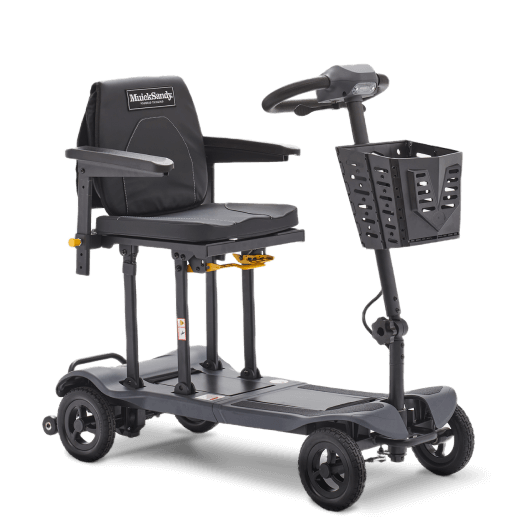
Our M-1 mobility scooter, for example, combines a maximum range of 28.3 miles with suspension and a dismantling design. Its heaviest individual part weighs 11.6kg, making it easier to manage when you want to take your scooter with you in the car.
Not sure what will suit you best? We're here to help. You can also try a scooter at home and see how it feels in your own surroundings, with no pressure.
Single and dual motor mobility scooter FAQs
Do dual motor mobility scooters handle hills better?
They can, particularly when the scooter has been designed to provide higher torque for steeper or more demanding terrain.
However, two motors alone don't guarantee better hill performance. Check the scooter's maximum gradient, tyres, weight capacity, gearing and manufacturer guidance before deciding whether it's suitable for your routes.
Are dual motor scooters heavier and harder to put in a car boot?
Some are, but not all.
Two motors add extra components, but overall scooter weight also depends on the battery, frame, seat and other equipment. Some dual motor scooters are designed to dismantle for transport.
If car travel matters to you, check the total weight, heaviest part and dimensions of the individual scooter.
Do I need a dual motor scooter if I only ride on pavements?
Not necessarily.
For smooth pavements, shops and everyday local journeys, a well-designed single motor scooter can provide all the performance you need.
Think about the routes you use, the gradients you encounter and how portable you need your scooter to be rather than choosing by motor count alone.
Do all dual motor mobility scooters have zero-turn steering?
No.
Some dual motor scooters use independent control of the powered wheels to achieve very tight turning circles. But zero-turn or near-zero-turn manoeuvrability depends on the scooter's complete steering and drive design, not simply the fact that it has two motors.
Always check the stated turning radius if manoeuvrability is important to you.