

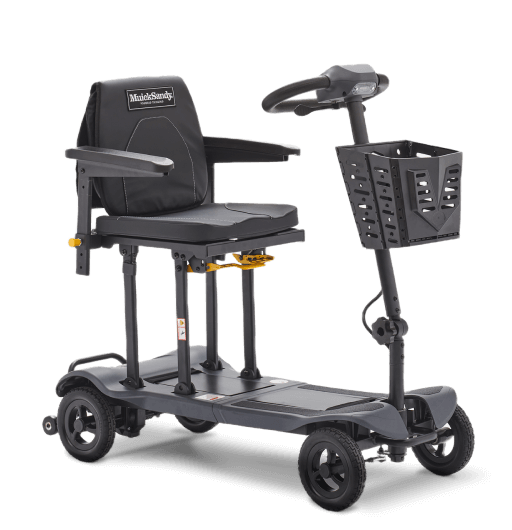



Whether you’re planning ahead or looking for an immediate replacement, we’re often asked how much a mobility scooter battery costs. The answer depends on a few things, including the battery type, capacity, brand and warranty. And if you only need one or a pair.
Read on for more information on typical price ranges for mobility scooter batteries in the UK, what affects them, how long batteries tend to last and what charging really costs. You’ll also find easy next steps if you’d like some help matching the right option for your mobility scooter.
How much does a mobility scooter battery cost in the UK?
Most UK replacement battery packs (that’s the full set your scooter needs) are in the region of £50 to £450 depending on what you buy and how you use your scooter. As a guide:
-
Capacity (Ah): higher Ah = longer range and higher price.
-
Chemistry: SLA/AGM (sealed lead-acid) are usually the lowest cost, gel a step up, and lithium higher again.
-
Brand and warranty: trusted brands and longer warranties can add to the price.
-
One battery or a pair: many scooters use two 12-volt batteries (24V) and are often replaced together.
What you can expect to pay:
-
Entry SLA/AGM: from around £30 each for smaller capacities.
-
Gel: typically from about £48 each.
-
Full replacement sets: often into the low hundreds once you factor in two higher-capacity batteries.
-
Lithium: typically around £200 to £450 or more per pack, depending on capacity and whether it’s a brand-specific pack.
What affects the cost of a mobility scooter battery?
A number of different things affect battery prices, including capacity (how much energy the battery can store) and chemistry (the type of battery inside).
Add in brand and warranty, plus whether your scooter needs a standard size or a model-specific pack, and you’ve got the main reasons why different batteries cost different amounts.
Capacity (Ah)
Think of Ah as the size of the fuel tank. Higher Ah means more range between charges. These batteries use more materials and are often larger, so they usually cost more than lower-capacity options.
Chemistry (battery type)
-
SLA/AGM (sealed lead-acid): the most common and usually the lowest upfront cost. Heavier, but dependable for everyday use.
-
Gel: similar to lead-acid but with a gel electrolyte that tolerates deeper discharges. Often a step up in price.
-
Lithium: much lighter with different performance characteristics. Higher upfront price, chosen for weight saving and convenience.
Lead-acid vs gel vs lithium mobility scooter batteries: lead-acid is lowest upfront, gel a step up, lithium the lightest and highest cost.
Brand and warranty
Well-known brands and longer warranties may add to the price but can offer extra peace of mind.
Design and fit
Some scooters use compact cases or shaped packs with built-in electronics. Purpose-made packs can cost more than standard rectangular batteries.
If you need some help choosing a battery, don’t hesitate to get in touch with us. Simply share your scooter model and how you use it, and we’ll help you find a safe, suitable option.
Do mobility scooters use one or two batteries?
Many mobility scooters run on two 12-volt batteries linked together. This is called “in series” and it gives the scooter 24 volts overall. You don’t have to be technical to understand it. Just think of it as two small batteries working as one larger pack to provide the power your scooter needs.
Because the two batteries work as a team, it’s usually best to replace them as a pair. Mixing a new battery with an old one can unbalance the set, which may reduce range and shorten the life of the new battery.
Some scooters do use a single battery instead, so it’s worth checking your manual or looking at the battery compartment to be sure.
How long do mobility scooter batteries last?
Most mobility scooter batteries last around one to three years. In everyday use, many people find they replace them about every two years. How you charge and store the battery makes a big difference to where you land in that range.
Some quick tips to help you get the most from your battery include:
-
Charge regularly – top up after use rather than running it flat.
-
Avoid deep discharges – try not to leave the battery empty for long.
-
Store it well – keep it somewhere dry, cool and off a cold floor.
-
Use it often – regular use keeps the battery healthy. If storing, give it a charge every few weeks.
-
Replace as a pair – if your battery pack’s a pair, matching ages helps both batteries last longer.
If your range is dropping, the scooter feels sluggish or charging doesn’t seem to hold, it may be time to replace your scooter battery.
How much does it cost to charge a mobility scooter?
Very little. A full charge typically uses around 0.3 to 1.0 kWh of electricity (this varies with battery size and how empty it is). On a tariff where electricity costs 26p per kWh, that works out at about 8p to 26p per full charge.
To put that into everyday numbers:
-
Light use (two charges a week at around 20p each) = 40p/week, £1.73/month, £21/year.
-
Moderate use (three charges a week at around 20p each) = 60p/week, £2.60/month, £31/year.
-
Regular use (four charges a week at around 20p each) = 80p/week, £3.47/month, £42/year.
-
Heavy use (five charges a week at around 20p each) = £1.00/week, £4.33/month, £52/year.
Based on these examples, a mobility scooter costs roughly £20 to £50 a year to charge. Your exact cost will depend on your electricity unit rate, the size of your battery and how often you charge.
Checklist: how to choose the right mobility scooter battery
A few details make matching a battery simple. You can usually find them on your scooter manual, the battery label or the sticker on your charger.
-
Your scooter make and model. This confirms the physical fit and any model-specific packs.
-
Voltage and capacity. Note 12V or 24V (many scooters use two 12V batteries in series), plus the capacity in Ah (amp-hours). Higher Ah = more range and often a higher price.
-
Battery type. Look for SLA/AGM, gel or lithium (often shown as “AGM”, “GEL” or “Li-ion”).
-
Size and terminals. The battery dimensions and the terminal tab size (often marked F1/F2) help confirm a safe fit.
-
Charger details. The charger model and its output (volts/amps) from the sticker make sure everything is compatible.
-
How you use your scooter. Typical weekly mileage, hills/rough paths and whether you need a lighter battery to lift can influence the best choice.
-
Age/condition of your current battery. When it was last replaced and any symptoms (reduced range, slow charging) help spot issues early.
-
Travel needs. If you fly with your scooter, be aware that some airlines have rules about lithium battery sizes.
If any of this is unclear, send us a quick photo of the battery or charger label and we should be able to confirm a suitable match for you.
Next steps: find the right replacement battery or scooter
Now you’ve got the key details like your model, voltage, Ah and battery type, get in touch and we’ll confirm a safe, compatible battery for you. If your scooter runs on a pair, we’ll check that too and advise on delivery or fitting.
If you’re considering a new scooter, think about what you need from it. Things like how far you travel, whether you’ll lift it into a car and the surfaces you ride on.
When portability matters most, explore our compact folding scooters to see models designed for quick, easy storage.
If lifting is your priority, take a look at our lightweight scooters. They’re built to be easier to carry, so getting out and about stays simple.
Prefer to try before you decide? You can book a home demonstration and see how a scooter fits your space and lifestyle.
Need a new mobility scooter battery? Get in touch with us
Once you know your battery type, capacity (Ah) and whether you need one or a pair, it’s easy to get a new one sorted. If you’d like a hand, share your scooter model and how you use it. We’ll confirm a safe, compatible battery and explain your options.
And if you’re thinking about a new mobility scooter, order your free brochure today.
Mobility scooter battery cost FAQs
How much is a mobility scooter battery in the UK?
Most replacement battery packs usually cost around £50-£300. Price depends on capacity (Ah), battery type and brand/warranty. As a guide: SLA/AGM are usually ~£30-£70 each (pairs ~£60-£140), gel ~£48-£100 each (pairs ~£100-£200) and complete higher-capacity sets reach the low hundreds. Lithium packs are typically ~£200-£450+ depending on capacity and brand. Prices vary by capacity (Ah), battery type and brand/warranty.
Do I need to replace both batteries at once?
If your scooter uses two 12V batteries (24V), it’s usually best to replace them as a pair. Mixing a new battery with an old one can reduce range and shorten the life of the new battery.
How long do mobility scooter batteries last?
Typically one to three years in everyday use. Many people replace at around two years. Charging regularly, avoiding deep discharges and storing the scooter somewhere dry and temperate can help you reach the upper end of that range.
What does charging cost per day or year?
On a tariff where electricity costs 26p/kWh, a full charge is about 8p to 26p depending on battery size and how empty it is. In simple usage examples, that’s roughly £20 to £30 a year to charge.
Why do some batteries cost more?
Three main reasons. 1. capacity (Ah) (more range costs more), 2. chemistry (SLA/AGM → gel → lithium, in rising order of price) and 3. brand/warranty (quality control and longer cover can add cost). Model-specific packs and built-in electronics can also affect price.