


If you’re planning a holiday or visiting family abroad, you might be wondering how much it costs to take a mobility scooter on a plane. The good news is that most UK airlines carry mobility scooters free of charge when you let them know in advance.
In this guide, you’ll find clear answers on what airlines charge, when costs can apply, how to prepare your scooter for travel and what to expect at the airport. Here’s what to know about taking your mobility scooter on a plane and how to make the journey as smooth as possible.
Can you take a mobility scooter on a plane?
Most UK and European airlines accept mobility scooters on board flights, and they’re carried free of charge as part of your mobility assistance rights. However, to make sure everything goes smoothly, you’ll usually need to tell your airline about your scooter at least 48 hours before you travel. This helps them prepare space in the aircraft hold and arrange any support you might need at the airport.
Every UK airport also provides free special assistance to help you check in, board and collect your scooter at your destination. Whether you’re flying with British Airways, easyJet or Ryanair, staff are trained to handle mobility equipment safely.
Travelling with your scooter is simpler than most people think, so with a little preparation it can be completely stress-free.
How much does it cost to take a mobility scooter on a plane?
For most UK flights, it costs nothing to take your mobility scooter on a plane. Under UK and EU regulations, every passenger with reduced mobility has the right to carry two mobility items free of charge, as long as you let the airline know at least 48 hours before departure. These items aren’t counted as part of your baggage allowance.
This is how a few major airlines handle mobility scooters.
-
British Airways — Free to carry, not included in your baggage allowance.
-
easyJet — Free, though extra medical or non-essential items above the two-item limit may incur a charge.
-
Jet2 — Two mobility aids free of charge. The airline recommends travel insurance for full cover beyond standard compensation limits.
-
TUI Airways — Two free mobility aids per passenger. Additional items may attract a handling fee.
-
Ryanair — Two free mobility aids per passenger.
In short, most travellers pay nothing at all, but the key is providing your scooter’s details early so the airline can plan ahead.
If you’re thinking about a travel-friendly scooter, explore our lightweight range or folding range, all designed for easy transport and smooth journeys abroad.
When could extra costs apply?
It’s rare to face extra charges when flying with a mobility scooter, but there are a few exceptions to be aware of. Costs can apply if you travel with more than two mobility items, like a scooter, spare batteries or a wheelchair.
Some airlines also offer an optional value declaration, which lets you insure your scooter above the standard compensation limit, which is around £1,100 under the Montreal Convention. Be aware, a small fee might apply for this.
If your scooter is particularly valuable, it’s worth arranging travel insurance to cover full replacement costs. It may be unlikely you’ll need it, but being prepared can help avoid any surprises and keep your journey calm and worry-free.
How to prepare your mobility scooter for air travel
A little preparation makes flying with your scooter simple and stress-free. Here are five quick tips to help everything go smoothly.
-
Notify your airline at least 48 hours before your flight so they can arrange handling and assistance.
-
Share your scooter’s make, model, weight and battery type when you book. This helps the airline plan space in the aircraft hold.
-
Confirm your two free mobility items to avoid confusion at check-in.
-
Follow battery and packing rules. Your airline will guide you if batteries need to be removed or disconnected.
-
Label your scooter clearly with your name and contact details.
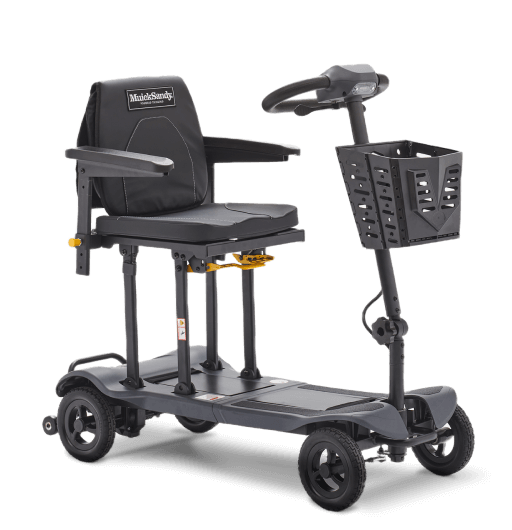
Folding or lightweight scooters are easiest to handle at airports and abroad. Muick Sandy scooters are designed to fold quickly and travel comfortably, giving you the freedom to explore with confidence.
Are there rules about mobility scooter batteries?
All airlines follow safety rules for carrying batteries, but they’re straightforward once you know what to expect.
Most mobility scooters use sealed lead-acid or small lithium batteries, both of which are accepted on UK and EU flights within set size and power limits. These rules are there to keep everyone safe, not to add cost or complexity.
Depending on the type, your airline may ask you to disconnect or remove the battery before loading your scooter into the hold.
What if your mobility scooter is damaged or lost?
Airlines are responsible for looking after your mobility scooter throughout your journey. If it’s ever damaged or lost, you’re protected under the Montreal Convention, which sets compensation limits for luggage and mobility aids.
The standard limit is around £1,100, but you can pay for a special declaration of interest before travel if your scooter is worth more than that. It’s a good idea to keep receipts and serial numbers and make sure your travel insurance covers full replacement value.
Issues are rare, but knowing your rights helps you travel with calm confidence and peace of mind.
Should you take your scooter or hire abroad?
If you rely on your scooter day to day, taking it with you is usually the best choice. You’ll travel with something you know, trust and feel comfortable using. Your own scooter is set up to suit you and you’ll avoid the uncertainty of hiring equipment in another country.
Hiring abroad can work for short trips or destinations with limited access, but availability and quality can vary.
Travel without compromise
Flying with your mobility scooter is easier and often cheaper than many people expect. Most UK airlines carry scooters free of charge and with a little preparation, you can enjoy smooth, confident travel wherever you’re heading.
Remember to let your airline know in advance, follow battery and packing rules, and keep your details handy. A bit of planning goes a long way.
If you’d like a scooter that’s built for easy travel, explore our lightweight range. Both the M-1 and M-2 are crafted in the UK, designed to fold, pack and go, giving you freedom to live life your way. Explore our lightweight range to get started.
Mobility scooter on a plane FAQs
Do you have to pay to take a mobility scooter on a plane?
Most UK airlines carry up to two mobility items free of charge under UK and EU passenger rights. Your scooter isn’t part of your baggage allowance, but you’ll need to tell the airline about it at least 48 hours before travel.
Can I take my folding scooter as hand luggage?
Mobility scooters travel safely in the aircraft hold, but folding models are much easier for staff to handle and fit neatly into cargo areas. If you use a lightweight folding scooter, you’ll usually be able to drive it right to the departure gate and maybe even the aircraft door.
Are batteries allowed on planes?
Airlines allow sealed lead-acid and small lithium batteries within safe size limits. They may need to be disconnected or removed during the flight. Your airline will guide you through the process to keep your scooter safe and your journey straightforward.
What documents do I need?
You’ll need to provide your scooter’s make, model, dimensions and battery type when you notify the airline. Some carriers may also ask for the battery watt-hour rating if it’s lithium. Having these details ready helps check-in go quickly and smoothly.
Should I get insurance?
While most airlines handle scooters carefully, travel insurance makes sure you’re fully covered for loss or damage beyond standard limits. It’s a small step that offers big peace of mind. Especially for higher-value or brand-new scooters.