



If you’re wondering how to get a folding mobility scooter into a car, you’re not alone. Lots of people worry about weight, boot space or how to lift a scooter safely. Especially if they’ve never done it before. Thankfully, it’s usually pretty easy. With the right scooter, that is.
So join us as we take you through your options, from lightweight folding scooters for car boots to ramps, hoists and everyday tips to help you feel confident and in control.
Can you fit a folding mobility scooter into a car?
With the right scooter and the right loading method, you can absolutely fit a folding mobility scooter into a car. Whether it’s weight, boot size or safe lifting, these challenges are usually easier to manage than you might think.
The key things to think about when loading a mobility scooter into a car are:
-
Size when folded
-
Overall weight and how it’s lifted
-
Your car boot dimensions
-
Whether the scooter folds in one piece or separates into smaller parts
Folding scooters collapse into a compact shape, while you take other scooters apart into lighter pieces. Both options can work well for car travel. It just depends on what feels easier for you to lift and handle.
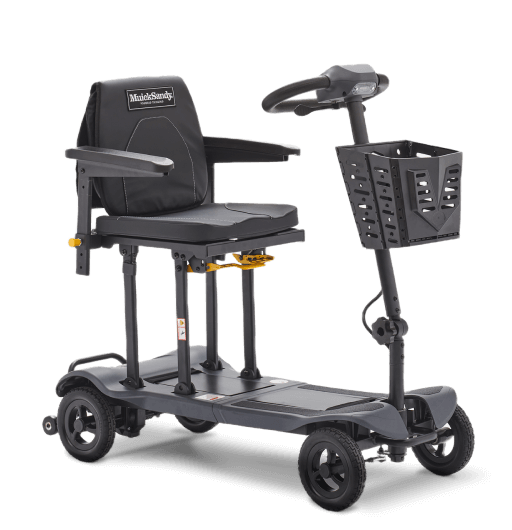
Many modern scooters, including the Muick Sandy ProFold F-1 and F-3 models, are designed with car travel in mind. They fold smoothly, fit into most UK car boots and keep lifting to a minimum, helping you feel confident from the very first try.
Choosing a mobility scooter that suits car travel
If you’re looking for the best scooter for car travel, it’s important to choose the right type. The way a scooter folds, separates or lifts has a big impact on how simple it is to load. Especially if you travel often or prefer to manage things independently.
Folding vs take-apart scooters: What’s the difference?
-
Folding scooters collapse in one piece, usually in a quick, single movement. They’re ideal if you want the simplest loading method with the least number of steps. Once folded, they form a compact, easy-to-handle shape that fits neatly into most boots.
-
Take-apart scooters separate into several lighter parts. Each piece is easier to lift than the full scooter, which can be helpful if you prefer smaller, more manageable weights. They take a little longer to load, but many people find this style easier to lift.
Both designs work well for car travel. It’s really about what feels easiest for you, your strength and your routine.
Features to look for in a portable mobility scooter
A few features can make a big difference when choosing a scooter for car journeys.
-
Lightweight frame. Scooters under 15kg are easier to lift and manoeuvre.
-
Simple folding mechanism. Look for a smooth, minimal-effort fold.
-
Removable battery. Makes lifting lighter and charging more convenient.
-
Compact folded size. Helps the scooter fit into a wider range of UK car boots.
Many of our scooters are designed with these needs in mind, combining lightweight materials with easy folding to make travelling as easy as possible.
Will your mobility scooter fit in your car boot?
Before you travel, check whether you have the right boot size for the mobility scooter.
Most folding and portable scooters are designed with car travel in mind, but the fit depends on the scooter’s folded size, your car, and how you load it. A quick measure should tell you whether your boot’s big enough.
How to measure your boot
To check boot size, measure the length, width and height of the boot opening, as well as the space inside once the parcel shelf is removed.
Different types of cars offer different levels of space. For example, coupes tend to have smaller openings, estates offer longer load areas and SUVs usually have more height. Hatchback boots are often convenient because of the way they open.
Don’t worry if your boot is on the smaller side. Lots of people use loading aids such as ramps or hoists to make the process easier, even with compact cars.
Protecting your interior
To keep your boot in good condition, consider using a mat, liner or protective cover. These can help prevent scratches from folded frames, protect upholstery from dirt or moisture and make sliding the scooter into place smoother.
A small boot organiser or wedge can also help keep the scooter steady during travel.
How to get your scooter into the car
There’s no single right way to get a folding mobility scooter into a car. It’s all about finding a method that feels safe, comfortable and manageable for you.
From simple manual lifts to ramps, hoists and carriers, we’ve listed the most common ways people load their scooters below. Each has its advantages, depending on your scooter, your car and how confident you feel lifting.
Manual lifting
Manual lifting can work well for very lightweight scooters, especially ones designed for travel. If you’re lifting on your own, keep the scooter close to your body, bend your knees rather than your back and avoid twisting as you lift.
It’s always safer to take your time. For heavier scooters, or simply for peace of mind, get two people to lift if possible, with one person lifting from each side.
Using a portable ramp
Portable ramps are a great choice if you travel solo or prefer not to lift. Telescopic and folding ramps allow you to roll the scooter straight into the boot, reducing effort and strain.
When choosing a mobility scooter ramp for your car, think about its storage space, the angle it creates with your boot and the surface you’re loading from. Flat, level ground is safest.
Ramps also help if your car boot opening is higher than average, like with many SUVs.
Using a boot hoist or lift
A boot hoist is a power-assisted system fitted inside your car that raises and lowers your scooter for you. It’s ideal if you load your scooter regularly or want to avoid lifting altogether.
Car hoists for mobility scooters vary in size and capacity, and while they do require installation, many people find them life-changing for independence. There may be UK funding options available through certain schemes or charities, depending on your circumstances.
Hitch-mounted carriers
A hitch-mounted carrier fits on the back of your car, so you don’t need to lift the scooter into the boot at all. Instead, the scooter is secured externally.
These carriers require a compatible tow bar and are less common in everyday use, but they’re a practical option if your car boot is small or lifting is difficult.
Keeping your mobility scooter safe during travel
Once your scooter is folded up and in the car, a few simple checks can help keep it secure on the move.
-
Turn the scooter off before loading and travelling.
-
Remove loose parts, such as baskets or the battery, so nothing moves around.
-
Position the scooter flat in the boot so it sits securely.
-
Use straps, wedges or a boot organiser to stop the scooter sliding, especially during braking.
-
Avoid travelling with an unsecured scooter, even for short trips, as sudden stops can cause it to move.
Whenever you need to transport a mobility scooter, a little preparation can make your journey feel safer, smoother and more stress-free.
Mobility scooter loading tips and common questions
Wherever you’re off to, it doesn’t take much to make sure you get there without any problems. We’ve put together some common questions you might have when travelling with a mobility scooter in the UK, and some tips for how to do so safely.
Can I load my scooter into a car by myself?
-
Yes, if the scooter is lightweight and you feel confident.
-
Many people use ramps or hoists to avoid lifting.
-
If in doubt, ask a family member to help until you feel comfortable.
Is it okay to load a scooter into a car in the rain?
-
Yes, but try to keep the battery and controls dry.
-
Wipe the scooter before storing it in the car.
-
Take extra care with your footing on wet surfaces.
What if I need to park in a tight spot?
-
Look for a space with room behind the boot if using a ramp.
-
For small spaces, loading from the pavement side can be easier.
-
Practice at home to get used to different angles and techniques.
What should I check before every trip?
-
Battery charged and ready
-
Tyres inflated
-
Ramp packed (if using one)
-
Boot cleared so the scooter fits safely
-
Any loose parts removed before loading
Need help choosing a mobility scooter that fits your car?
If you’re still unsure which scooter will fit your car or suit your routine, you don’t have to figure it out alone. At Muick Sandy, we design and build some of the very best lightweight folding mobility scooters in the UK.
Our friendly UK team can talk you through your options, help you compare sizes and suggest models that match your strength, boot space and confidence level, like the F-1 Carbon with its patented Step2Fold system.
You can even try a scooter at home with a free demonstration, so you can see exactly how it feels to fold, lift and load in your own time.
FAQs about loading a folding mobility scooter into a car
What’s the lightest folding mobility scooter for car travel?
Lightweight folding scooters are designed to make lifting and loading easier. Some models weigh under 15kg, which helps reduce strain when lifting into a boot. Choose one of the lightest scooter that still feels stable, comfortable and suited to your everyday journeys.
Can I transport my scooter without help?
Yes, many people load their folding scooter independently, especially if it’s lightweight or used with a ramp. If lifting feels difficult, a boot hoist or two-person lift can make things safer. Practise loading at home to help build your confidence.
Do I need a special car for a mobility scooter?
No. From hatchbacks to SUVs, most folding and portable scooters fit standard UK cars. Measuring your boot opening and choosing a compact scooter can help keep things easy. Ramps or hoists can also help if your boot height is higher than average.
Are ramps or hoists better for loading a scooter?
It depends on your strength, car type and how often you travel. Ramps are great for solo use and don’t require installation. Hoists offer effortless lifting and are ideal if you load your scooter regularly. Both options can make loading safer and more manageable.