

Finding the right mobility scooter starts with feeling confident it will work in your home. One of the first questions you may have is whether it will fit through your doorway.
So, do mobility scooters fit through standard doorways in the UK? In this guide, we’ll answer this question as well as give you clear, simple steps to help you check your doorway and choose a scooter that fits your life comfortably.
What is the standard width of a doorway in the UK?
Most UK internal doors are between 76–81 cm wide, while external doors are often a little wider. But the number on paper isn’t always the space you can actually use. Door frames, hinges and raised thresholds all reduce the clear opening, which you drive through.
UK building regulations (Part M) recommend a clear opening of around 77.5 cm for easier access. Many newer homes follow this, but older British properties often have narrower doors, especially in hallways and kitchens.
Essentially, if your internal door measures 76 cm, the usable space might be closer to 73 cm once the door is fully open. That difference matters when choosing a scooter that feels comfortable to use every day.
How wide are mobility scooters?
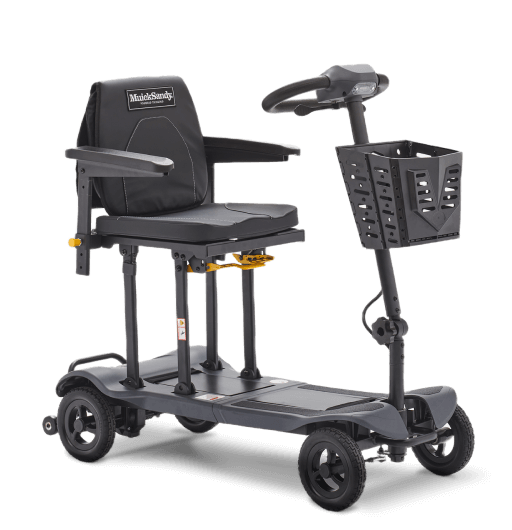
Mobility scooters come in a range of widths, so it helps to understand the typical sizes before comparing them to your doorway. Most travel or portable scooters, including Muick Sandy’s lightweight, fold-friendly models, are the narrowest at around 50–60 cm wide. These are ideal if you want something easy to manoeuvre indoors.
Mid-size scooters are usually 60–65 cm wide, giving you a little more comfort without taking up too much space. Full-size outdoor scooters can be 65–70 cm or more, especially with larger tyres for uneven ground.
Always check the scooter’s widest point, not just the body. Armrests, wheels and accessories can add a few extra centimetres. This helps you match the right scooter to your doorway with confidence.
Will a mobility scooter fit through your doorway?
The easiest way to check is to measure both the doorway and the scooter, then give yourself a little extra room for comfort. Start with the doorway:
-
Measure the narrowest point of the clear opening with the door fully open.
-
Measure the scooter’s widest point, including armrests or accessories.
-
Allow at least 5–10 cm clearance on each side so you can move through smoothly.
As a quick guide, a 60 cm scooter works best with 70–75 cm of space. It also helps to test how the door swings, check the hallway width and look for anything that might get in the way.
Most travel scooters, including Muick Sandy’s compact, portable models, will fit easily through standard UK doorways.
What if your doorway is too narrow for a mobility scooter?
If your doorway feels a little tight, don’t worry. There are several simple ways to make things work without major changes. You could choose a narrower or folding scooter, like one of Muick Sandy’s lightweight, travel-friendly models designed for smaller spaces. Often, a compact scooter is all you need.
Some homes also benefit from small adjustments, like repositioning hinges, removing an internal door, or using offset hinges that increase the clear opening. These are usually low-cost and quick for a professional to fit. A threshold ramp can also help you glide smoothly over raised lips or uneven edges.
Whatever your home layout, there’s almost always a solution. And if you’d like guidance, we’re here to help you explore the best options for your space.
What else should you consider for mobility scooter indoor access?
Once your scooter fits through the doorway, it’s worth thinking about how it moves around the rest of your home. Turning radius makes a big difference indoors, especially in hallways, kitchens and bedrooms. A smaller turning circle helps you move around furniture with ease.
Look at your flooring too. Smooth, even surfaces feel more comfortable and help protect your scooter’s battery. Rearranging furniture slightly can open up clearer paths and make rooms feel more accessible.
To keep your walls and doors looking their best, simple bump strips or soft corner guards can reduce scuffs. And remember, your scooter should make daily life simpler, not stressful. The right setup helps you move around confidently and enjoy your independence at home.
Finding the right mobility scooter for your home
When you’re choosing a mobility scooter for indoor use, focus on overall width, weight, turning circle and how easy it is to fold or lift if you need to store it. Narrower and travel-friendly models often feel most comfortable in the home, especially if you have older doorways or compact rooms.
Muick Sandy offers a range of narrow-width and folding scooters, crafted to give you freedom without taking up extra space. Every model is designed with care, attention to detail and the reassurance of being crafted in the UK.
If you’d like to see how a scooter works in your home, you can try it at home. And if you ever need advice, we’re here to help you find the perfect fit.
Get the brochure
Most mobility scooters, especially compact and travel-friendly models, fit comfortably through standard UK doorways. And if yours is a little narrower, there are always simple ways to make access easier. The goal is to help you move with confidence at home and enjoy freedom to live life your way.
When you’re ready, explore our range of compact, easy-fit scooters by requesting a brochure and starting your journey with us.
Mobility scooter size FAQs
What size door does a mobility scooter need?
Most mobility scooters need a clear door opening of around 70 to 75 cm to pass through comfortably. However, this can vary depending on the model, especially with larger or heavy-duty scooters. It's important to measure both the scooter's widest point and the actual usable door width, not just the frame, to ensure a good fit.
Can I use a full-size scooter indoors?
It’s possible to use a full-size mobility scooter indoors, but it often depends on the layout of your home. These scooters tend to be wider and have a larger turning radius, which can make navigating through narrow doorways or tight corners difficult. For everyday indoor use, a compact or travel scooter is usually more practical and easier to handle.
Are all mobility scooters the same width?
No, mobility scooters come in a variety of widths. Smaller, portable models are typically around 50 to 55 cm wide, while standard and heavy-duty scooters can exceed 70 cm. The width directly affects manoeuvrability, so it’s worth considering where and how you plan to use the scooter before choosing one.
How do I measure my doorway for a mobility scooter?
To measure your doorway, open the door fully and measure the narrowest point of the opening, not just the frame width. This includes accounting for any obstructions like hinges or doorstops. It’s this clear opening that determines whether your scooter can fit through easily.
What’s the narrowest mobility scooter you can buy?
The narrowest mobility scooters are usually lightweight travel models, which are designed to be compact and easy to transport. Many of these have a width of around 50 to 55 cm, making them ideal for smaller doorways, indoor use, and tight spaces.