

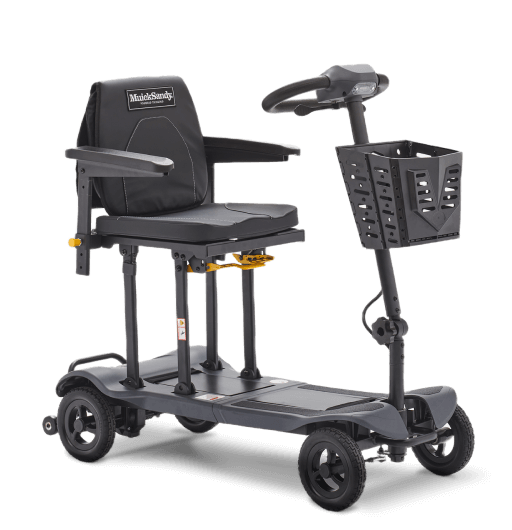



Thinking about the everyday running cost of a mobility scooter? You won’t have to think long, because it’s tiny. For most people in the UK, a full charge only costs a few pence. Often less than making a cup of tea at home.
You can work out your exact cost in minutes using a simple sum. So put the kettle on, settle down and read on as we take a closer look at how much it costs to charge a mobility scooter.
How much does it cost to charge a mobility scooter in the UK?
The cost of charging is easy once you know the sum you need to do. Every scooter battery holds a certain amount of energy and your electricity supplier charges you a set price for each unit of electricity you use. Put those two numbers together and you’ll know what a full charge really costs.
In simple terms, the formula for working out how much it costs to charge a mobility scooter is:
Battery capacity (in kWh) x your electricity unit rate (p/kWh) = cost per full charge
For most mobility scooters, a full charge uses between 0.3 and 1.0 kWh of electricity. At an electricity unit rate of 26p per kWh, that works out to roughly 8p to 26p per charge. Even if you charge a few times a week, this usually only adds up to a few pounds per month.
Your own figure will depend on your scooter’s battery size and the tariff on your bill, so it’s best to check your latest rate. Remember, the standing charge on your bill is separate, we’re only looking at the energy used to charge the scooter itself here.
Example: mobility scooter charging cost explained
Let’s say your scooter has a battery pack made up of two 12-volt, 42-amp-hour batteries connected in series. Together that means a 24V 42Ah pack, which stores about 1.0 kWh of energy and sits at the top end of the typical range.
Using an electricity rate of 26p per kWh, a full charge works out at 26p. If you fully charged this scooter three times a week, that comes to about 78p per week, which is roughly £3.40 per month or £40 per year.
Remember this is just an example. Your exact cost depends on your battery, your electricity tariff and how often you charge.
How to calculate your mobility scooter charging cost step by step
Every scooter is a little different, but you can work out your own charging cost in just a few minutes. Here’s how:
-
Find your battery size. Look on the label of your battery or in your scooter’s manual. You might see it written in watt-hours (Wh), or as volts (V) and amp-hours (Ah).
-
Convert to kilowatt-hours (kWh). If the capacity is shown in Wh, simply divide by 1,000. For example, 500Wh ÷ 1,000 = 0.5kWh. If it’s written as V and Ah, multiply them together, then divide by 1,000. For example, 24V x 42Ah = 1,008Wh ≈ 1.0kWh.
-
Multiply by your electricity rate. Check your latest electricity bill for your unit rate (shown in pence per kWh). Multiply your battery size (kWh) by this rate to get the cost of a full charge.
-
Work out weekly, monthly or yearly costs. Think about how often you charge. Multiply the cost per charge by the number of charges per week, then by 52 for a yearly figure.
That’s it. No special tools needed, just your battery label and your electricity bill.
What affects the cost of charging a mobility scooter?
The cost of a full charge is always low, but a few factors can nudge it up or down. The main ones include:
Battery size and state of charge
Larger batteries naturally take more energy to fill. Most mobility scooters use between 0.3 and 1.0 kWh for a full charge. If your battery is already half full, topping up will cost less.
How often you charge
If you charge every day, you’ll spend a little more overall than if you only charge two or three times a week. Either way, we’re still talking pennies per charge.
Your electricity tariff
Your home tariff (shown in pence per kWh on your bill) is the biggest variable. If you’re on an off-peak or special EV tariff, charging overnight could be cheaper. If your tariff is higher, costs will rise proportionally.
Charger behaviour
Most modern chargers reduce their power draw once the battery is full. Even so, it’s best practice to unplug when charged and follow your scooter’s manual. This keeps costs down and helps care for your battery.
How much does charging a mobility scooter cost per week, month and year?
When you look at it over time, the running cost stays small.
-
Per full charge. Most scooters use 0.3–1.0 kWh, so at 26p/kWh that’s roughly 8p to 26p each time.
-
Per week. If you charge two to three times a week, that’s about 16 to 78p per week (lower end for smaller batteries, higher for larger).
-
Per month. For regular use (two to three charges a week), it’s typically around £1 to £4 per month.
-
Per year. That’s roughly £15 to £40 per year for regular use.
Your own figure depends on battery size, how often you charge and your tariff, so run the quick calculation with your bill’s p/kWh rate to get it. Whatever it comes to, the running cost of electricity is tiny. Especially when you think of the freedom a mobility scooter offers.
Tips to keep mobility scooter charging costs low and extend battery life
Even though charging your scooter is inexpensive, it’s always nice to make some little savings along the way. Follow these simple tips to save some money while also getting the best life out of your battery.
-
Charge in a safe, ventilated space – this keeps your charger and battery cool and working efficiently.
-
Check your cables and connections – make sure leads are secure and free from damage before plugging in.
-
Avoid extreme temperatures – batteries last longer if they aren’t exposed to very hot or very cold conditions.
-
Unplug once full – many modern chargers reduce their draw once the battery is topped up, but it’s usually best to disconnect once charging is complete.
-
Follow the manual – every scooter is a little different, so stick to the charging advice in your handbook.
As well as helping with charging costs, these steps can also help your battery last longer. With good care, most scooter batteries last one to three years, and many people find they only need to replace them about every two years.
Discover Muick Sandy mobility scooters built for everyday freedom
Low charging costs are just one part of the picture. The right scooter can make everyday journeys simpler, more comfortable and more enjoyable. At Muick Sandy, we design mobility scooters that are lightweight, reliable and built to fit your life.
-
F-Series – folding, travel-friendly scooters like the F-3 that are easy to lift and store.
-
M-Series – modular scooters including the M1 that come apart in five pieces, balancing portability with comfort.
-
R-Series – road-class scooters with serious power and range for longer trips.
All of our scooters are made in the UK and backed by caring, expert support. Want to browse our full range? Order your free brochure now.
Get in touch with us for a chat and book your free home demo
As you’ve seen, charging a mobility scooter typically costs only a matter of pence per full charge. Using the steps above, you can work out your own exact cost in moments.
At Muick Sandy, we believe independence should feel easy and stress-free. Part of this is offering free home demonstrations across the UK. You can see how a scooter fits into your daily life, ask as many questions as you like and take your time deciding.
Book a free home demo to try a scooter at home, no pressure. We’re here to help.
Mobility scooter charging cost FAQs
How much does it cost to charge a mobility scooter?
A full charge typically costs between 8p and 26p at a UK rate of 26p per kWh. Your exact figure depends on your scooter’s battery size, your tariff and how often you charge.
How do I calculate my mobility scooter charging cost?
It’s simple to work out your own cost:
1. Find your battery size (Wh, or V × Ah)
2. Convert to kilowatt-hours (kWh)
3. Multiply by your electricity rate (p/kWh)
That gives you the cost of one full charge.
How much could charging a mobility scooter add to my electricity bill?
For most people, the impact is very small. If you charge your scooter two to three times per week, it usually adds about £1 to £4 per month to your electricity bill, or around £15 to £40 per year.
Is it cheaper to charge overnight?
It can be. If your tariff has an off-peak rate, such as Economy 7 or an EV/night-time tariff. In those cases, charging during the off-peak window costs less per kWh. If you’re on a single-rate tariff, it costs the same whenever you plug in. Check your bill or app for your unit rates and off-peak hours.
Do I need to unplug once it’s full?
Most modern chargers draw very little once the battery is topped up. Even so, it’s best practice to unplug once charging is complete and follow your scooter’s manual.
What does a replacement battery cost and how long do they last?
Most scooter batteries cost between £50 and £300, depending on size and type. With good care, they usually last one to three years. Many people replace their batteries about every two years.
Are Muick Sandy scooters expensive to run?
Not at all. All our scooters are fully electric and designed to be efficient. Charging costs are only pennies per use, and ongoing care is supported by our UK-based team.