

At a glance
-
Four-wheel mobility scooters are generally more stable outdoors, especially on uneven ground, slopes and longer journeys.
-
Three-wheel mobility scooters are often easier to use indoors because their tighter turning circle helps in smaller spaces.
-
The safest choice depends on where you will use the scooter, your balance and the design of the individual model.
-
Stability is not only about wheel count. Suspension, tyre size, wheelbase and ground clearance also matter.
-
Always try a mobility scooter before buying to make sure it feels comfortable, easy to control and right for your usual journeys.
Which is safer, a 3 or 4 wheel mobility scooter?
Wheel count is only part of the decision. Your balance, confidence, usual routes and the design of the scooter all matter too.
Is a 3-wheel or 4-wheel mobility scooter safer?
A four-wheel scooter is generally the safer choice for outdoor use. Its wider base and four contact points with the ground usually make it feel more stable on uneven or sloping surfaces.
A three-wheel scooter has one front wheel and two rear wheels. This gives it a smaller mobility scooter turning circle, so it can turn in less space. That can make it easier to control in shops, lifts and narrow hallways.
The main difference is simple:
-
Four wheels usually offer more stability
-
Three wheels usually offer more manoeuvrability
|
Factor |
3-wheel scooter |
4-wheel scooter |
|
Stability |
Best on smooth, level surfaces |
Usually more stable overall |
|
Turning circle |
Tighter |
Wider |
|
Indoor use |
Often easier |
Depends on size |
|
Outdoor use |
Suitable models can manage it |
Usually better suited |
|
Uneven ground |
More care needed |
Generally the better option |
|
Legroom |
Often more open |
Varies by model |
Neither design is impossible to tip. Sharp turns, excessive speed, uneven ground and poorly positioned loads can affect any scooter.
Why are four-wheel mobility scooters more stable?
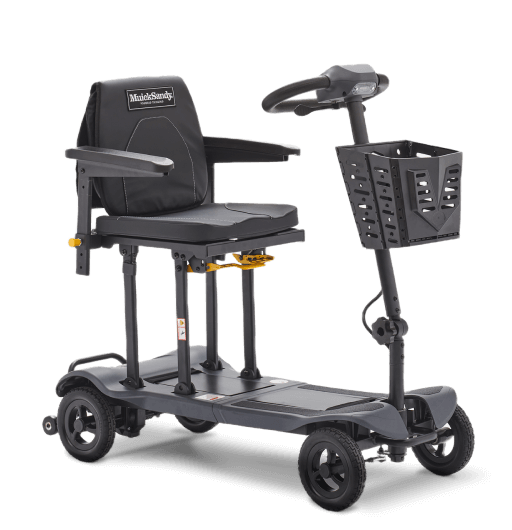
A four-wheel scooter has two wheels at the front and two at the back. This creates a wider base and spreads weight more evenly. That can make it a better choice when you regularly travel over:
-
Cracked or uneven paving
-
Dropped kerbs
-
Gentle hills
-
Sloping pavements
-
Grass or gravel
-
Longer outdoor routes
A four-wheel model may be the best mobility scooter for uneven ground, but wheel count is only one factor. Mobility scooter stability also depends on:
-
Wheelbase: The distance between the front and rear wheels
-
Track width: The distance between wheels on the same axle
-
Tyre size: Larger tyres may handle rough surfaces better
-
Suspension: This absorbs some movement over bumps
-
Ground clearance: The space between the scooter and the ground
-
Seat position: A correctly adjusted seat helps you remain balanced
-
Speed: Fast turns increase sideways force
A compact folding four-wheel scooter won’t behave in the same way as a larger outdoor model. Always check what the individual scooter is designed to handle.
When can a three-wheel scooter be the safer choice?
Safety is also about being able to steer accurately and avoid obstacles.
A three-wheel mobility scooter can be the safer practical option in confined indoor spaces because its tighter turning circle reduces the need for repeated reversing and repositioning. It may work well in:
-
Supermarkets
-
Shopping centres
-
Lifts
-
Narrow corridors
-
Smaller homes
Some three-wheel models also provide more open legroom around the front wheel. This can be useful if you’re tall or find a more enclosed foot area uncomfortable.
Three-wheel scooters can be used outdoors where the model is designed for it. However, they may require more care on broken pavements and sideways slopes.
A sideways slope is sometimes called a camber or crossfall. It can make the scooter lean to one side, so a four-wheel model may feel more secure if your local routes include steep or uneven cambers.
Which scooter is safest for different environments?
The safest option depends on where you will use it most.
|
Environment |
Likely best starting point |
|
Home and narrow indoor spaces |
3-wheel or compact 4-wheel |
|
Shops and shopping centres |
3-wheel or compact 4-wheel |
|
Smooth pavements |
Either |
|
Uneven pavements |
4-wheel |
|
Hills and cambers |
Usually 4-wheel |
|
Grass or gravel |
Larger 4-wheel model |
|
Mixed indoor and outdoor use |
Compact 4-wheel |
Indoors
A three-wheel scooter is often easier to turn indoors. A compact four-wheel model can also work well, but it should be tested in your tightest spaces.
You can compare smaller models within our folding mobility scooter range, while checking their dimensions and turning radius.
Pavements and slopes
Four-wheel scooters tend to offer more confidence on uneven pavements and gentle slopes.
Use dropped kerbs where possible and stay within the manufacturer’s stated kerb and gradient limits.
A pavement mobility scooter may be suitable for everyday local journeys, while larger road mobility scooters are designed for longer-distance use.
What matters besides wheel count?
A general 3 wheel vs 4 wheel mobility scooter comparison is useful, but you should also check:
-
Turning radius
-
Overall width
-
Tyre size
-
Suspension
-
Ground clearance
-
Maximum user weight
-
Maximum safe gradient
-
Braking controls
-
Anti-tip features
-
Seat comfort
-
Transport weight
The maximum user weight tells you how much load the scooter is designed to carry. It doesn’t automatically mean the scooter is more stable.
The maximum gradient is the steepest incline the manufacturer says the scooter can handle under stated conditions. Never rely on a general online figure over the model’s specific instructions.
Which scooter suits different users?
When choosing the right scooter, your needs should guide the decision:
-
If you mainly travel indoors: A three-wheel scooter may be easier to control because it can turn in less space.
-
If you have reduced balance: A four-wheel scooter will provide a more reassuring base. A demonstration or assessment is still important because posture, coordination and control also affect safety.
-
If you need more legroom: Some three-wheel scooters offer a more open front section. Test the seat, tiller and foot space before deciding.
-
If you need to transport it by car: Lightweight three-wheel and four-wheel models are available. Check the total weight and the weight of the heaviest part.
-
If you travel indoors and outdoors: A compact four-wheel model can offer a useful balance between manoeuvrability and stability.
How to test a mobility scooter before buying
A test drive should reflect the journeys you make in real life. Check whether you can:
-
Get on and off safely
-
Reach the controls comfortably
-
Start and stop smoothly
-
Make slow turns
-
Reverse confidently
-
Pass through a doorway
-
Remain comfortable for several minutes
-
See the area around the scooter
-
Carry normal items safely
-
Control it on a typical outdoor surface
A home demonstration can be particularly useful because it lets you test doors, paths, storage areas and local pavements. Try both configurations where possible.
Mobility scooter safety tips
Whichever scooter you choose:
-
Slow down before turning
-
Avoid sudden changes of direction
-
Use approved baskets or holders
-
Stay within the user and load limits
-
Avoid travelling sideways across steep slopes
-
Check tyres regularly
-
Follow the charging instructions
-
Read the manufacturer’s manual
-
Arrange regular mobility scooter servicing
UK Class 2 scooters are limited to 4 mph and are designed mainly for pavement use. Class 3 scooters can travel at up to 8 mph on roads where permitted, but must remain at 4 mph on pavements.
Get in touch to choose your scooter
A four-wheel mobility scooter is generally safer for outdoor use because it offers greater stability on uneven ground, slopes and longer journeys.
A three-wheel scooter may be the better choice indoors, where its smaller turning circle makes it easier to manoeuvre.
The safest option is the one that suits your body, confidence, local environment and daily routine. Compare the complete design, not just the number of wheels.
Get in touch to speak to our mobility specialist or arrange a demonstration to find a scooter that feels safe, comfortable and right for your everyday journeys.
3-wheel vs 4-wheel mobility scooter FAQs
Can a three-wheel mobility scooter tip over?
Yes. A three-wheel scooter may be more sensitive to sharp turns, uneven ground and sideways slopes. Slowing down and following the manufacturer’s guidance can reduce the risk.
Is a four-wheel scooter always safer?
No. It is usually more stable outdoors, but it may be harder to manoeuvre in confined spaces.
Which scooter is best for uneven ground?
A larger four-wheel scooter with suitable tyres, suspension and ground clearance is usually the better option.
What is a mobility scooter turning circle?
It is the amount of space the scooter needs to turn around. Three-wheel scooters usually have a smaller turning circle.
Which scooter is best for poor balance?
A four-wheel model is usually the better starting point, but an individual assessment or demonstration is recommended.