

At a glance
-
Outdoor scooters need good suspension, large pneumatic tyres, and high ground clearance to handle uneven British terrain safely.
-
Class 3 scooters are road-legal and reach 8 mph, while Class 2 models are restricted to 4 mph on pavements.
-
Cold weather and steep hills can reduce your battery range by up to 50% compared to manufacturer estimates.
-
Large Class 3 scooters are often unsuitable for public transport, making compact folding models a better choice for travel.
-
Ergonomic features like delta tillers and contoured seating help minimise chronic pain and joint stiffness during longer outdoor journeys.
Choosing the perfect scooter requires a bit of practical knowledge. You’ll need to understand how technical specifications translate to real-world British weather, uneven pavements and rolling hills. With this guide, you can confidently choose a scooter that keeps you moving safely and comfortably.
What makes a scooter suitable for outdoor use?
A good outdoor mobility scooter needs to feel steady, comfortable and easy to control over different surfaces.
Smaller indoor models may struggle on uneven pavements, while outdoor scooters are designed to cope with more demanding routes.
Full front and rear suspension
Good suspension can make a noticeable difference to your comfort.
It helps absorb movement from cobblestones, gravel paths and cracked pavements, so you feel fewer bumps through the seat and tiller.
If you regularly travel over uneven ground, look for a model with front and rear suspension.
Pneumatic tyres for grip
Your tyres affect grip, comfort and control.
Larger pneumatic tyres can provide more cushioning on rough ground because they are filled with air. They may also offer better grip on wet paths, loose gravel and muddy surfaces.
Check the tyre size and type before choosing a scooter, and make sure you are comfortable checking the pressure if the tyres need regular inflation.
High ground clearance
When you leave flat indoor floors behind, ground clearance becomes a vital safety feature. A scooter with high ground clearance ensures you can clear twigs, small rocks and low kerbs without scraping the underside. This protects the delicate transaxle and battery casing from damage. Here are the main hardware features to check:
-
Full front and rear active suspension
-
Large pneumatic tyres (ideally 12 inches or more)
-
High ground clearance to avoid scraping on kerbs
-
A powerful motor capable of maintaining torque on inclines
Having these features ensures you can stay active, explore country paths and enjoy your local area with total peace of mind.
What’s the difference between Class 2 and Class 3 mobility scooters?
The main difference between Class 2 and Class 3 mobility scooters is where they can be used and how fast they can travel.
Class 2 scooters are limited to 4 mph. They are mainly designed for pavements, footpaths and pedestrian areas, and they do not need to be registered with the DVLA.
Class 3 scooters can travel at up to 8 mph on the road. They must be registered with the DVLA and limited to 4 mph when used on pavements.
You must be at least 14 years old to drive a Class 3 scooter.
Class 3 road legal mobility scooters cannot be used in cycle lanes, bus lanes or on motorways.
Knowing the difference can help you choose a scooter that suits the journeys you plan to make.
How British weather and hills affect battery life
Manufacturer brochures often list impressive battery ranges, but these laboratory figures are tested under absolute perfect conditions. In the real world, the damp British weather and rolling hills will impact your actual mileage. This is why understanding the technology behind your power source is so helpful.
Cold winter weather is one of the biggest challenges for any electric vehicle battery. Industry data shows that cold temperatures can cause up to a 35% reduction in overall battery range. Climbing steep inclines or traversing rough, muddy grass increases rolling resistance, which can slash your battery range by 30% to 50% compared to flat, dry concrete.
To prevent range anxiety, expert guidelines recommend choosing a model with a listed range that's 20% to 30% higher than your actual daily travel needs. This buffer keeps you safe and moving.
Here's how the two primary battery types compare on outdoor journeys:
|
Battery feature |
Sealed Lead Acid (SLA) |
Lithium-Ion |
|
Weight |
Heavy and bulky |
Lightweight and compact |
|
Hill performance |
Rapid voltage drop on steep slopes |
Consistent power delivery |
|
Cold weather impact |
High capacity loss in winter |
Moderate capacity loss in winter |
|
Lifespan |
Shorter (approx. 300 charge cycles) |
Longer (approx. 1000+ charge cycles) |
By planning for these real-world factors, you can enjoy your outdoor adventures without worrying about your charge.
Can you take your outdoor mobility scooter on British public transport?
Combining your mobility scooter with public transport is a fantastic way to expand your horizons and enjoy longer days out. However, taking a scooter on British trains and buses requires a bit of forward planning because operators have different rules.
Most transport providers have strict limits on the maximum dimensions and weight they can safely accommodate on board.
Heavy-duty Class 3 machines are often too large or heavy for the standard ramps used by bus and train operators. If you regularly use public transport, a compact, folding model is generally much more practical. These clever designs allow you to fold the scooter down in seconds, making it easier to store in luggage racks or car boots than a fixed scooter.
With a bit of research into your local transport providers, you can seamlessly combine scooter journeys with train or bus travel. It's a wonderfully empowering way to visit family, explore new towns and maintain your active independence.
Staying safe on British roads and pathways
Staying safe while exploring is the key to maintaining your confidence outdoors. Taking time to learn safe path navigation and basic observation will help you feel relaxed and secure on every outing. Here are some simple, practical safety habits to keep in mind:
-
Wear high-visibility clothing or a reflective vest when travelling near roads
-
Always turn on your front and rear lights as dusk approaches
-
Take extra care and reduce your speed when transitioning from roads to pavements
-
Make eye contact with drivers before crossing junctions or driveways
-
Keep your speed set to the lower 4 mph limit when around pedestrians
By incorporating these sensible habits into your routine, you can protect yourself and those around you.
Choosing comfort for chronic pain
Longer outdoor journeys are wonderful, but they can be physically demanding if you experience joint stiffness or chronic pain. When you're travelling over uneven ground, your body feels every minor vibration. This makes ergonomic design a critical consideration.
A delta tiller is an incredibly helpful feature for anyone who experiences discomfort in their hands or wrists. This wraparound steering handle lets you rest your hands comfortably and steer using just your fingers or palms, preventing wrist fatigue. Contoured seating and high-quality shock absorption are also essential to excellent posture support and long-distance comfort over longer distances.
Discover the freedom of the M-Series
Choosing the best mobility scooter for outdoor use means looking beyond basic specifications to understand how suspension, tyres and battery range perform in real-world British conditions. By matching your travel habits with the correct legal class and prioritising ergonomic comfort, you can find a reliable scooter that restores your outdoor freedom and keeps you exploring with confidence.
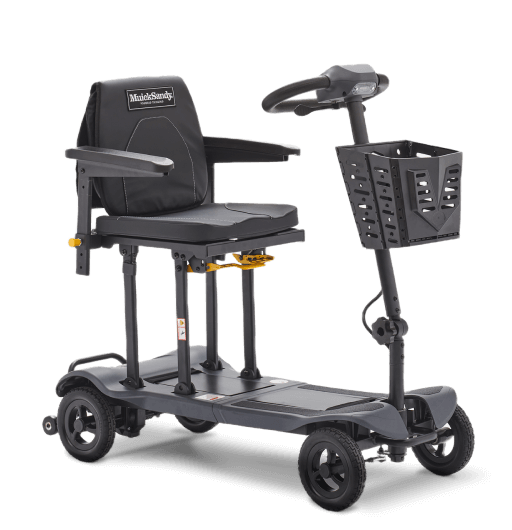
If you're looking for a comfortable, reliable companion for your outdoor journeys, we're here to help. Explore our range of highly supportive, portable options by checking out the M-Series mobility scooters.
Or, why not book a stress-free, complimentary home demonstration today with absolutely no pressure to buy?
Outdoor mobility scooter FAQs
Can I drive an 8 mph mobility scooter on the pavement?
Yes, but you must limit it to 4 mph when travelling on pavements or in pedestrian areas.
You cannot drive at 8 mph on the pavement.
Can a mobility scooter handle steep hills?
Some outdoor mobility scooters can manage moderate hills.
Always check the manufacturer’s maximum safe gradient for the individual model. Hills can also reduce battery range, especially when travelled regularly.
Can you use a mobility scooter in the rain?
Many mobility scooters can be used in light rain, but they should not be driven through deep water or left exposed to heavy rain.
Follow the manufacturer’s guidance and keep the scooter dry when it is not in use.
Can I get help through the Motability Scheme for an outdoor scooter?
You may be able to lease a mobility scooter through the Motability Scheme if you receive an eligible mobility allowance.
Eligibility depends on the allowance you receive and how long remains on your award